
Common Functions of Optical Thin‑Films (HR, AR, BS, AT, FI, PBS, PC)
Link:https://blog.jdr.ltd/home/article/detail/id/53.html
Optical thin films refer to one or more layers of films deposited on the surface of polished optical components to modify the transmission characteristics of light waves. According to different application requirements, the common functions of optical thin films include seven categories: High Reflection (HR), Anti-Reflection (AR), Beam Splitting (BS), Attenuating (AT), Filtering (FI), Polarizing Control (PBS), and Phase Change (PC). In addition, there are functional films with non-optical properties such as hydrophobic and conductive (ITO) films. This article introduces the principles, typical specifications and common materials of these functions one by one, helping readers gain a comprehensive understanding of this field.
1. What are Optical Thin Films?
In the early days, optical components made of glass were susceptible to erosion by water vapor, acids, alkalis and other substances in the air during use, which degraded surface performance and shortened the service life of optical products. To solve this problem, optical coating technology emerged: depositing a thin film on the surface of optical lenses to isolate the polished surface from air and protect the optical surface.
In subsequent applications, researchers found that thin films could not only protect optical surfaces but also alter the optical properties of light beams, for example, changing the transmittance or reflectance of the surface. This discovery drove further research into coating technology. Modern optical coating is a process of depositing one or more thin films on polished optical parts. Its purpose is to change the transmission characteristics of light waves, including transmission, reflection, absorption, scattering, polarization and phase change of light, or to achieve other specific goals via optical thin films.
2. Common Functions of Optical Thin Films
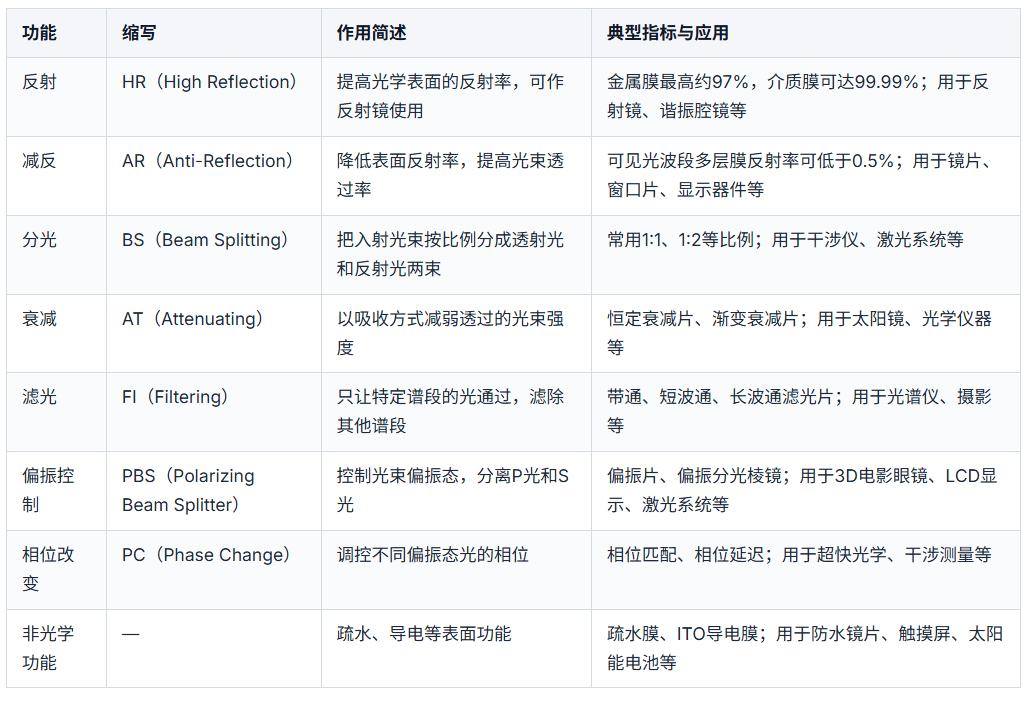
What are the common functions of optical thin films? When defining coating requirements on optical drawings, three items usually need to be clarified: first, the applicable spectral range, such as coating requirements for ultraviolet, visible or infrared bands; second, the incident angle of light on the film layer to meet the specific application requirements of the optical component in the optical system; third, the numerical indicators after coating, such as whether the reflectance needs to be lower than 0.5% or higher than 96%. According to different application scenarios, the common functions of optical thin films can be summarized into seven categories (plus one category of non-optical functions), as outlined below:
A. High Reflection (HR Coating)
Films with this function are called reflective films, often referred to as high-reflection films (HR films). They are used to increase the reflectivity of optical surfaces, and optical surfaces coated with HR films can serve as mirrors.
Different reflectivity specifications correspond to different coating film systems. Common reflective films fall into two main types: metal films such as aluminum, silver and gold films. Metal films are generally thin, well preserving the surface figure, with a maximum reflectivity of around 97%. The other type is dielectric films (dielectric coatings), formed by stacking different dielectric materials. For instance, a dielectric reflective film combining magnesium fluoride (MgF₂) and tantalum pentoxide (Ta₂O₅) can reach a reflectivity of 99.99%. However, dielectric films are usually thicker, making it difficult to maintain high-precision surface figure. As an example, the figure below shows the reflectance curves of gold, silver, aluminum and dielectric films coated on BK7 substrates in the visible band:
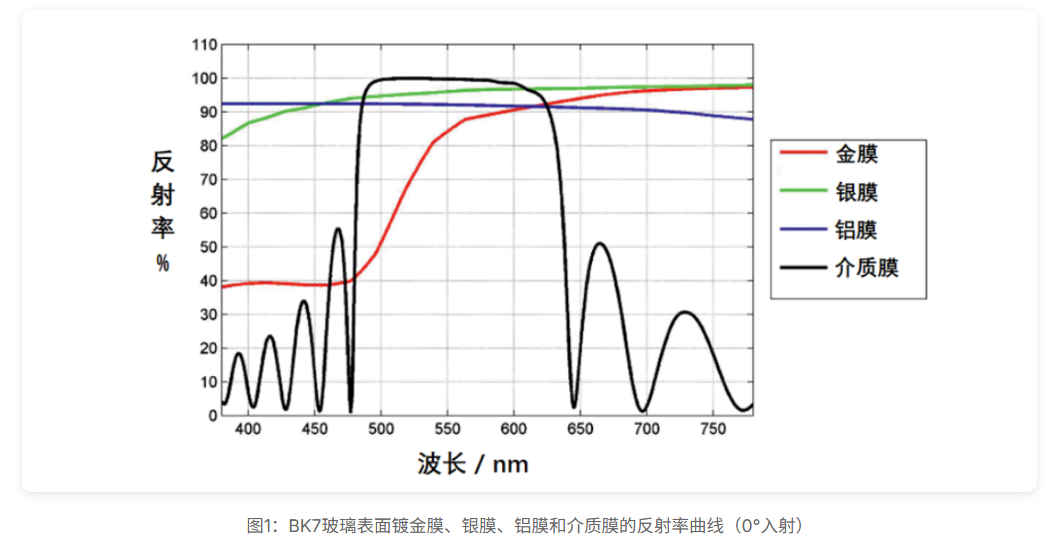
In the figure above, the light beam is incident at 0°. The red line represents gold film, the green line silver film, the blue line aluminum film, and the black line dielectric film. This dielectric film consists of 10 layers of MgF₂ and 11 layers of Ta₂O₅, with a total MgF₂ thickness of 66 nm and a total Ta₂O₅ thickness of 99 nm. It delivers the highest reflectance among all listed film systems.
B. Anti-Reflection (AR Coating)
Films with this function are known as anti-reflection or anti-reflective coatings. They reduce the reflectance of optical surfaces within a specific spectral range and thereby raise the transmittance of light through the component. Anti-reflection films are usually stacked from one or multiple dielectric materials; MgF₂ and Ta₂O₅ are widely used here. The figure below shows the surface reflectance curves of uncoated BK7, single-layer coated BK7 and multi-layer coated BK7 in the visible band:
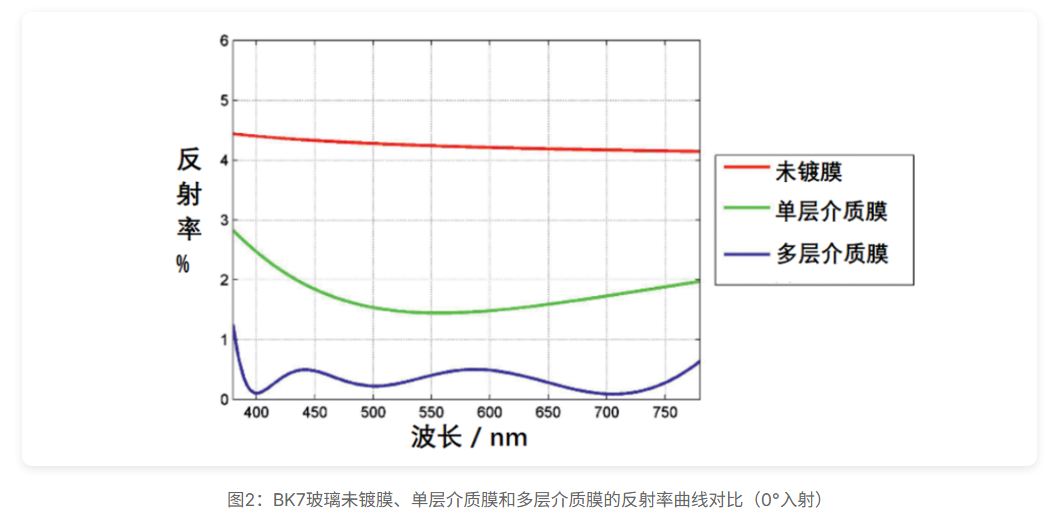
The light beam is incident at 0°. The red line stands for uncoated polished BK7 surface with a reflectance of approximately 4.2%; the green line is the reflectance curve of the substrate coated with a single-layer MgF₂ film of ~99 nm thickness, which achieves obvious reflectance reduction; the blue line represents the substrate coated with 3 layers of MgF₂ and 3 layers of Ta₂O₅. At this point, the surface reflectance drops below 0.5%.
Available coating materials are not limited to MgF₂ and Ta₂O₅. A wide range of fluorides, oxides and other compounds are adopted in practice. Common fluorides include lanthanum fluoride (LaF₃), yttrium fluoride (YF₃), ytterbium fluoride (YbF₃), etc. Common oxides include silicon dioxide (SiO₂), titanium dioxide (TiO₂), zirconium dioxide (ZrO₂), hafnium dioxide (HfO₂), etc. In addition, compounds such as zinc sulfide (ZnS) and zinc selenide (ZnSe) are also used.
C. Beam Splitting
By coating, an incident light beam on the coated surface can be split into two beams: one transmitted through the surface and the other reflected. The intensity ratio of the two beams can be defined during film system design. A common option is a 1:1 beam splitter film, where transmitted and reflected light each account for half of the total intensity. In practical applications, 1:2 and other custom splitting ratios are also available.
D. Attenuating
Coating on flat optical substrates weakens the intensity of transmitted light. The lost light is absorbed by the film layer rather than reflected back, realizing light attenuation. Sunglasses we wear daily can absorb ultraviolet rays and attenuate light intensity to protect eyes. In optical instruments, there are neutral density filters with constant attenuation rate, which attenuate the incident light uniformly across the whole aperture. Gradient neutral density filters are another type: when rotated around the center, their transmittance changes continuously from high to low.
Take Yangtian Eletro-Optics (Jilin) Co., Ltd as an example. It holds multiple patented technologies for attenuators, with a complete intellectual property layout covering film system design, coating process and testing methods. The relevant patents cover both constant and gradient attenuator solutions, including key links such as film material ratio, film thickness control and transmittance uniformity adjustment. While guaranteeing attenuation accuracy, these products maintain favorable surface figure and stability, providing reliable customized attenuators for scientific research and industrial customers.
E. Filtering
Components for filtering functions are generally called optical filters. They allow light of specific spectral bands to pass through while blocking unwanted spectral bands. Filters are widely used in optical instruments. Classified by spectral characteristics, they include bandpass filters, short-wave pass filters, long-wave pass filters and more. In photography, filters serve as color selectors to capture photos with special artistic effects.
F. Polarizing Control
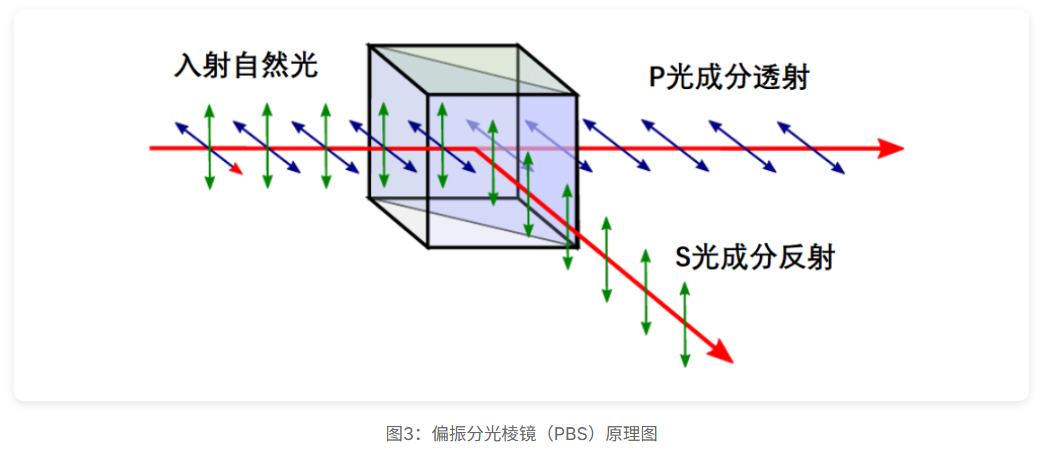
We know linearly polarized light is divided into P-polarization and S-polarization. Their vibration directions are perpendicular to each other and they propagate independently. Coating can control the polarization state of incident light. Typical applications include polarizers that convert natural light into polarized light, widely used in 3D movie glasses and LCD displays. The Polarizing Beam Splitter (PBS), commonly used in optical instruments, is fabricated by depositing polarizing coating on the inclined surface of cemented right-angle prisms. It splits incident light into P-light (transmitted) and S-light (reflected), exiting perpendicularly to each other for polarization generation. The schematic diagram of PBS is shown below:
G. Phase Change
As mentioned above, optical thin films are stacks of one or multiple dielectric layers. When light is reflected or refracted at interfaces between different dielectrics, the phase of light with different polarization states changes. Based on this property, optical thin films can be used to regulate the phase of P and S polarized components of incident light, with common applications such as phase matching and phase retardation.
H. Non-optical Functional Films
There is another category of optical thin films that do not provide optical modulation functions yet are essential in practice. For example, hydrophobic coatings are applied when water resistance is required on optical surfaces. Such films prevent water droplets from adhering to lenses, so water slides off efficiently just like water droplets on lotus leaves. Some scenarios require conductive optical surfaces, where ITO (Indium Tin Oxide) coating is adopted. ITO films feature high transmittance in the visible band together with excellent conductivity, delivering transparent conductive functions for flat-panel displays, touch screens, solar cells and other electronic products.
3. Common Misconceptions
There are several confusing understandings about optical thin films worthy of attention during selection and application:
Misconception 1: Higher reflectivity is always better.
In fact, coating indicators must match the application. Mirrors require high reflectivity, while lenses and windows need reflectivity minimized (anti-reflection). Moreover, higher reflectivity usually comes with narrower bandwidth, higher sensitivity to incident angle and higher cost, so it is not suitable for all scenarios.
Misconception 2: Ignoring incident angle and spectral range.
The reflectance and transmittance specifications of a film are designed for a specific incident angle (such as 0° normal incidence or 45° oblique incidence) and a specific spectral range. Indicators will deviate significantly when the actual working conditions depart from the design conditions.
Misconception 3: Metal films are outdated, and dielectric films should be chosen for all applications.
Metal films feature wide reflection bandwidth, low angle sensitivity and mature low-cost processes, and remain mainstream choices for wide-band reflection and cost-sensitive scenarios. Dielectric films can achieve ultra-high reflectivity up to 99.99% with extremely low absorption. However, they have narrower bandwidth, stronger angle sensitivity and higher cost. Each type fits its own application.
Misconception 4: Coated optical components can be wiped arbitrarily.
Compared with bare glass, film layers are more fragile. High-power laser irradiation, humid or acid-base environments accelerate film aging and damage. Dry wiping and hard wiping should be avoided during cleaning; dedicated tools and solvents shall be used following standard procedures.
4. FAQ
What are the common functions of optical thin films?
There are seven main categories: High Reflection (HR), Anti-Reflection (AR), Beam Splitting (BS), Attenuating (AT), Filtering (FI), Polarizing Control (PBS) and Phase Change (PC). In addition, there are non-optical functional films such as hydrophobic films and ITO transparent conductive films.
What is the difference between HR coating and AR coating?
They work in opposite directions. HR (High Reflection) coating maximizes surface reflectance: metal films reach approximately 97% while dielectric films can reach 99.99%. Typical applications include mirrors and laser cavity mirrors. AR (Anti-Reflection) coating minimizes surface reflectance: multi-layer AR coatings for visible light can achieve reflectance below 0.5% to boost transmittance. Typical applications include lenses, windows and display devices.
What are the characteristics of metal films and dielectric films, and how to select them?
Metal films (aluminum, silver, gold, etc.) have wide reflection bandwidth, low sensitivity to incident angle, mature technology and low cost. Their maximum reflectance is generally around 97%, but they introduce absorption loss. They are suitable for wide-band reflection and cost-sensitive scenarios. Dielectric films are stacked by alternating high and low refractive index materials. They can reach 99.99% reflectance with negligible absorption, yet they are thicker, have narrower bandwidth, are sensitive to incident angle and cost more. They are suitable for laser systems demanding high reflectance and low loss.
What is PBS and what is it used for?
PBS stands for Polarizing Beam Splitter. A polarizing beam-splitting film is coated on the inclined surface of cemented right-angle prisms. It splits incident light into P-light (transmitted) and S-light (reflected), which are linearly polarized light with perpendicular vibration directions and exit perpendicularly. PBS is widely used in laser systems, optical isolators, optical metrology and display equipment for polarization generation, polarization analysis and polarization beam splitting.
What are the common coating materials for optical coatings?
Common coating materials include low-refractive-index materials: magnesium fluoride (MgF₂), lanthanum fluoride (LaF₃), yttrium fluoride (YF₃), ytterbium fluoride (YbF₃), silicon dioxide (SiO₂), etc. High-refractive-index materials: tantalum pentoxide (Ta₂O₅), titanium dioxide (TiO₂), zirconium dioxide (ZrO₂), hafnium dioxide (HfO₂), etc. In addition, compounds such as zinc sulfide (ZnS), zinc selenide (ZnSe), and metal coating materials including aluminum, silver and gold are also used. The final material combination is selected according to spectral range, target specifications and laser damage threshold requirements.
5. Conclusion
In this article, we have introduced the common functions of optical thin films. Depending on film systems, optical thin films can realize high reflection, anti-reflection, beam splitting, attenuation, filtering, polarization control and light phase modulation. Besides, hydrophobic films, ITO films and other non-optical functional films are also widely adopted in practice.
For customized optical thin films, film system simulation prototyping and mass coating services, contact Yangtian Electro-Optics (Jilin) Co., Ltd. We offer HR / AR / BS / PBS / ITO / hydrophobic coatings covering ultraviolet, visible and near-infrared bands, along with matched optical component processing. Standard coated optical components are available for selection on the Jiaderun Optics Mall.
